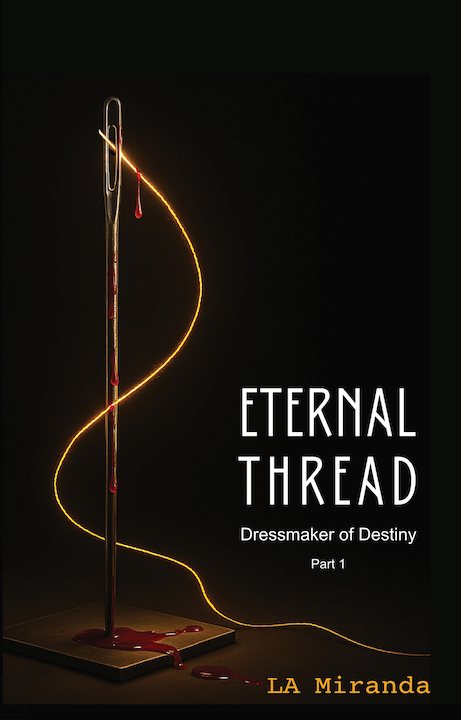
Eternal Thread
For over six hundred and fifty years, María has stitched her existence into the lining of history, a phantom hidden within the folds of the world’s most exquisite garments. She is a creature of contradictions—a predator who creates beauty, a monster who craves humanity, an immortal who measures time not in years, but in the rise and fall of hemlines.
Her story begins not in glory, but in the rot of 1350 Barcelona. At seventeen, amidst the Bubonic corpses of the Black Plague, María is forced to discover that eternity is a cold and hungry place when she was bitten by a rat that was infected by vampire's blood.
As the new progeny of Dimus's bloodline, she learns that her survival depends on the very thing she fears most—the theft of life. Her early years are a blur of horror and instinct, a desperate scramble to master the "dark gift" before it consumed her soul. But in the silence of her isolation, she discovers a thread of salvation: fashion.
It is in the gilded court of 18th-century France that María truly begins to live. Under the tutelage of the legendary Rose Bertin, she finds her purpose. Serving Marie Antoinette, she helps craft the iconic hairstyle of the "Pouf" and the extravagant gowns that define an era, learning that fabric can be armor and style can be a weapon. She moves through the glittering halls of Versailles, a predator in lace, hiding her deadly nature beneath layers of silk taffeta. But as the French Revolution dyes the streets of Paris red, María learns the first cruel lesson of immortality: everything she builds is destined to turn to ash by discovery.
The centuries roll on, and María reinvents herself again and again. In the smoke and jazz of 1920s Paris, she finds a kindred spirit of Coco. Together, they strip away the corsets of the past, liberating women with the Little Black Dress and the revolutionary scent of Coco's creation. But even as she shapes the modern woman, the shadow of the Avenging Knights—an ancient order of hunters sworn to eradicate her kind—creeps ever closer.
Her travels took her from Paris to the ashes of World War II in Germany to the neon promise of the New World.
*** End of Part 1 ***
*** Part 2 (arriving Summer 2026) continues ***
New York City in the 1970s offered a different kind of darkness. As the Director of the Costume Institute at the Met, María commanded the daylight world of high fashion, rubbing shoulders with influential men and woman of Fashion prestige and mentoring the next generation of designers. By night, she descended into the glittering underground of lounges and secret sex clubs, a world of drugs, disco, and debauchery. Here, she joins a clandestine fraternity of fashion immortal elites—Gianni, Karl, Jean-Paul—vampires who have shaped culture from the shadows. They tread a razor’s edge, balancing the "Red Pill" that dulls their hunger with the intoxicating rush of the live feed.
The decadence and indulgences comes with a price. When a feeding goes wrong and a relentless detective named Jimmy Calder uncovers her secret, María is forced to embrace the monster she has spent centuries denying, proving that even a muse can be a murderer.
Now, in the humid, moss-draped silence of 1980s Savannah, María seeks a final reinvention. She has traded the frenzy of New York for the slow, gothic charm of the South, hoping to find peace among the ghosts. But the eternal thread of her past is pulling tight. The Avenging Knights have not forgotten, and the sins of six centuries are coming due. From the ashes of Jim William’s antique business ruined by scandal, she prepares to unveil her life’s work in the Fashion House of Savannah—a memoir woven into a fashion collection—María must decide if she is finally ready to step out of the shadows, or if the only way to safeguard her legacy is to burn it all down.
Eternal Thread is an epic tapestry of history, horror, and Haute Couture. It is a story of a woman who has worn every mask the world has offered, only to find that the hardest face to look at is her own. From the plague pits of the Middle Ages to the runways of the modern world, María’s journey is a testament to the beauty of art, the enduring power of survival, the countless reinvention, and the terrible price of never being able to say goodbye.
Novel Preview:
Chapter 1: HER-STORY
Thick velvet drapes held back the last of the afternoon light. Lola stood at the window with the curtain edge between her two fingers, watching the street below. She had been standing there long enough to know she was not simply watching for the visitors.
In three years of managing María’s affairs, she had fielded inquiries, misdirected journalists, and quietly destroyed two separate contracts that would have brought cameras into this house. Today, she had signed the one that let them in. The weight of that was still settling.
A white van turned into one of Savannah’s most prestigious neighborhoods and parked in front of the house.
It must be them, Lola thought, letting the curtain fall before going to the door.
Elsie looked up at the house at 3 West Gordon Street, then at the woman in the doorway.
”Rain, traffic. Sorry we’re late,” Elsie said, not apologetically, as the others grabbed equipment cases and headed up the front stairs.
Lola presented a neutral face and softened her Spanish accent before kissing Elsie on both cheeks to welcome her. Elsie wasn’t used to this type of greeting. She stared blankly for a minute then asked “Where do we set up?” Lola directed them to the drawing room. Cases cracked open, tripods clicked upright, furniture shifted across centuries-old oriental rugs. Lola crossed her arms, stayed near the door, and watched. The low murmur of work filled the entrance hall.
She had told herself she would feel better once they arrived, that anticipation was the worst part. She did not feel better. What comes after today cannot be unrecorded.
Then the air in the room shifted—imperceptibly at first. The camera crew stopped working and looked up.
A woman, maybe sixty, with dark hair threaded with silver that flowed to her shoulders. She moved towards the guests. She seemed to glide rather than walk.
Elsie sensed something she couldn’t put her finger on. But even she could not ignore the undercurrent. Under her breath, she said, “Start recording.” One of the crew got behind the camera and pointed it at the woman standing before Elsie. Everyone else stayed still, mesmerized.
The woman turned toward them. The cameraman shifted the lens and zoomed in on her face.
“Welcome to the Fashion House of Savannah. I am María Laurent. You met Lola my Operations Director.”
“Hi, Ms. Laurent—I’m Elsie Bowerman. I—” She caught herself. “We spoke on the phone.”
María studied the woman with quiet intensity.
Elsie continued, “I’m the director. I’ll also be interviewing you.” She gestured behind her. “This is my crew.”
María greeted them as she looked around the room. “I see you’ve rearranged my room.” No one answered.
María tilted her head slightly, letting the silence stretch. Her eyes caught the yellow of the staging light, then turned away from the camera.
“Do you like my ensemble? It’s from my latest collection. I call it Illusion.”
She was dressed in white. The kind that read as simplicity until you looked at it directly—at which point, the construction became visible. A wrapped V-neck that fell into a skirt with no interruption, no seam at the waist, no break in the line.
“This is not two pieces,” she smiled. “No seam at the waist. One continuous form—beginning to end without division.” She smoothed the fabric once at her hip. “And it has pockets. The modern woman must have pockets. I have felt strongly about this for some time.”
Elsie knew nothing about fashion, but smiled and nodded politely.
“Shall we start?” she said. “As you noted, we rearranged your room so we could position your armchair in the center—giving the cameramen room to move freely around you.”
María nodded and lowered herself into the Baker armchair. She drew a slim case from her pocket. It was worn smooth at the corners. Her hand showed a slight tremor that she made no effort to conceal—she tipped a single red pill into her palm. Lola had a glass of water ready before María looked up for it. She swallowed the pill without comment. Lola retrieved the glass and said nothing.
Lola moved to María’s side and made a small adjustment to her shoulder—a fold in the white cotton that no one else had noticed. Then she stepped back and assessed the light. María glanced around the room, the subtle hum of electronics filling the silence—cables crisscrossing the floor.
María started to ask a question when Elsie cried out. The clipboard’s metal edge had caught her finger, and a thin line of blood began to form.
The scent reached María before Elsie’s cry. Something in María went still. Her pupils contracted. The room’s ambient noise—the hum of the equipment, the quiet breathing of the crew—receded entirely.
Elsie pressed her fingertip to her lips. María’s hands tightened almost imperceptibly in her lap. Her eyes focused on the cut. A half-second passed before she turned her gaze back toward Elsie.
Elsie, unaware, grabbed a tissue and adjusted her earpiece.
María asked her question. “Do I look at you or the camera when I reply to your questions?”
“Me,” she said. “The cameras will capture everything. We’ll handle the edits afterward—so don’t worry if you stop, pause, or look around the room. The most important content is the audio, capturing your story.” Then she looked back at her crew, nodded, turned back to María, and added, ”You can begin any time.”
María looked directly at Elsie. “There are some memories I will not share with you, because remembering has a cost. For the rest, history has a curious way of forgetting. It’s time those truths are spoken.”
She settled back into the chair, her hands folding neatly in her lap.
Elsie looked down at her clipboard reorganizing her thoughts. “Okay, let’s get some background information. State your name, when and where you were born.”
”My name is María Ferrer de la Ribera. I was born in Barcelona, Spain, during the reign of King Alfonso IV of Aragon on January 21, 1331.”
She spoke with a cadence—French layered under Castilian—that no one in the room could quite place.
“That would make you...” Elsie’s face went blank in deep thought.
“667 years old. 650 of them as a Vampire,” María stated matter-of-factly.
One of the crew laughed. Elsie glared at him before returning to her questions. “And your claim is supported by these two items?”
“Yes, they are.” María pointed to the open magazine on the side table. “I’m with Coco Chanel. I remember it well. We were at La Tour d’Argent. Coco was particularly fond of martinis.”
“So, you are saying that this is you, sitting next to Coco Chanel in the December 1937 edition of Harper’s Bazaar?”
“Yes.”
”And is this you, in a wedding gown next to a man in Edwardian clothing? I am assuming he is the groom.” Elsie held up a very aged, sepia-toned photograph.
”Yes, he was the groom. He was Charles Worth, a major fashion icon of the Victorian era. The photo was taken in the spring of 1858—turn it over; you’ll see the markings.”
”Where is he now? Whatever has kept you living these past centuries—did you share it with him?” Elsie’s voice remained steady.
María gave a small laugh. “He would be a hundred and seventy-three years old today, if he were still alive.” She smoothed the fabric at her knee with one hand.
There was a slight lilt in the way she spoke.
Elsie circled the question on her clipboard.
María let the silence sit a moment, then continued, ”I have dressed kings, queens, and emperors. I have dressed their families without any of them knowing what I am. I have watched movements begin and collapse and begin again.” She glanced once at the photo, then back to Elsie. “I say this not to impress you, but so you will understand it is not the confession of someone who has lived a simple life.”
”Perhaps in the telling of my story, you will understand and accept what I am about to tell you as truth.”
María paused. The words had lived inside her for over six centuries, spoken to a very few outside of her circle. Never like this. Never into a confession for the world to hear.
“So how have you managed to live more than six centuries?” Elsie asked with the flat straightforwardness of an interviewer.
María held Elsie’s gaze.
“I am a Vampire.”
Elsie’s mouth fell open. She quickly shut it. One of the crew let out a short laugh—not unkind, more involuntary—the kind that escapes before the brain can stop it. Elsie didn’t look at him. She kept her eyes on María.
The cameraman’s hands stayed on the rig. His eyes had left the viewfinder. The sound person glanced at Elsie, then back at his levels—which had gone flat—then back at Elsie again, as though one of them might tell him what to do next.
Elsie had walked into the house expecting an eccentric, wealthy woman with theatrical claims and good paperwork. The lawyers had vetted her. The photographs had passed three rounds of authentication. The contract had been the most unusual one Elsie had ever signed, but unusual was not the same as impossible, and she had built a career on the difference.
This was something else.
She made a small notation on her clipboard that meant nothing.
”You mean,” Elsie said carefully, “vampires. As in—drinking blood, hypnotizing people. Coffins.”
María’s expression did not change, but something behind her eyes did. A patience worn very thin.
She looked from Elsie to the cameraman, then to the sound recordist standing near the door with his boom pole dangling a microphone above her. She looked at each one individually.
”You are thinking of the stories,” she said. “The ones that have been written about us.”
No one contradicted her.
She folded her hands in her lap. “I was in Paris in 1897 when Bram Stoker’s novel appeared. I read it in a single night.” A pause. “He was not entirely wrong. There are those among us who sleep in the earth, who recoil from certain things, who leave the kind of traces that draw attention. They exist. I will not pretend otherwise. But they are the rarest of us—a few in every thousand, sometimes fewer. Writers found them because they were the only ones careless enough to be found. Vampires are not fiction.”
“The rest of us learned not to be found.”
Her eyes moved to the seam of light at the edge of the velvet drape, then back.
“Our kind is the majority. We do not have fangs. No turning into mist. No ash on the carpet at sunrise. We are the part of the story no one knew to write, because we knew to blend in. Our kind is real.” A small pause. “We move through the world as you do—because we learned to. Because survival has always required it. To be discovered would lead to being hunted, and then exterminated.”
Elsie kept her expression level. “And the blood?”
María met her eyes. “Yes, there is that.”
Elsie asked, “Why haven’t we heard of real stories of Vampires?”
“Some stories do surface—a death where the blood loss cannot be explained, attributed quickly to some kind of demonic worship ceremony. The Conducti exist to ensure that. They have been managing this for a very long time, and they are very good at it.”
A silence opened up in the room.
”The stories exist because it serves us,” María continued. “A monster in fiction is far easier to dismiss than a woman sitting across from you in a white dress.” She glanced down at the fabric at her knee, then back up. “Fear keeps people safe. Fiction keeps them comfortable. We understood that long before Mr. Stoker put pen to paper.”
”It’s what people know,” Elsie said, with a small, apologetic gesture toward the camera.
”Yes.” María set her hands flat on her knees. “It is what he decided people should know. He was not wrong about everything.” She paused. “He was wrong about the coffins.”
No one laughed this time.
Lola stood just beyond the staging light, arms crossed, thumbnail pressed to her lips. She looked once at Elsie, once at the camera crew.
María continued. “For too long, we have survived by being misunderstood,” she said. “Misinformation is a useful veil.”
She paused. A hairline fracture showed in her composure—barely there, but real.
“Not all of my kind will forgive this,” she continued. “Most thrive on secrecy. Not out of shame—out of control. They have lived in the shadows for so long, they mistake the dark for their domain.”
Elsie kept her face neutral, professional. The crew did not move.
“They will call what I am doing, betrayal. And betrayal has consequences.”
María paused.
“The story will be released when I’m gone?” she added, almost gently.
Elsie responded, “Just as you have specified in the contract.”
”What I am going to tell you is not the story the books told.” Her eyes moved across the crew, one face at a time. “It is the true story. The unknown one.” She looked directly at Elsie.
“I remember when the Bubonic Plague came.”
“Que Dios los acoja en su seno,” she murmured. God rest their souls.
Her eyes returned to the camera.
“I survived,” María whispered. “Had I not been turned, I would have died from the Black Death. As my family did. As forty million others did.”
Her eyes returned to Elsie. ”I can truthfully say that is when I lost everything—and gained everything. But in order for you to understand, we must begin at the beginning,” she said. “To the one who made it possible.”